
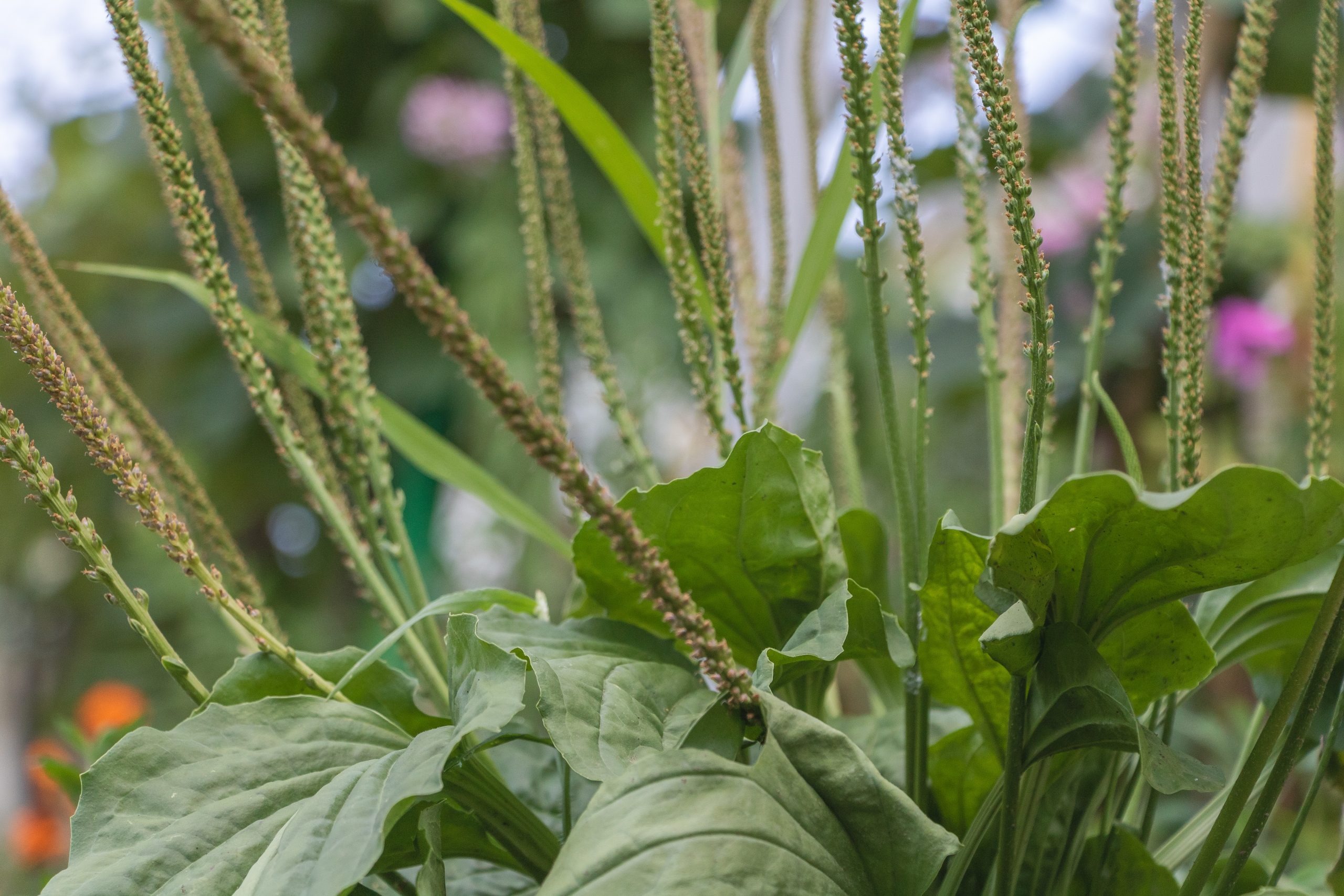

Plantago major, or, the broadleaf plantain, is a Eurasian plant commonly referred to as a weed in North America. It was likely introduced into the Americas during the seventeenth century and can now be found widespread across both Canada and the US. Plantain is an incredibly resilient plant, and thrives in almost any conditions, including compact or disturbed soil – as a result, Plantago major and other members of its genus tend to grow alongside human-made trails easily and are abundant in urban and agricultural settings.
This funky little flora has some interesting uses! Historically, the plant has been used for both its antibacterial and anti-inflammatory properties, often as a quick in-the-field remedy. Its use dates back as far as the Romans! Pliny the Elder, in The Natural History, describes Plantago lagopus and Plantago altissima, relatives of Plantago major, as having natural cauterizing properties. Traditional herbalism also utilizes plantain (and its relatives) for these purposes. Plantain poultices were (and still are) very common. That being said, urban and agricultural weeds are often treated with herbicides, so tread carefully should you decide to try it out.
The broadleaf plantain has since become a naturalized plant – as in, it no longer requires human intervention to spread or to be maintained, as is the case with many ornamental plants. Flora of this category may become invasive should they begin to diminish the resources available to native flora. At this time, Plantago major is typically considered to be invasive.
The next time you’re walking along the pavement, take a look at the ground! You might notice a small plant with round leaves and spike-like flower stems – that’s the plantain, always underfoot.