


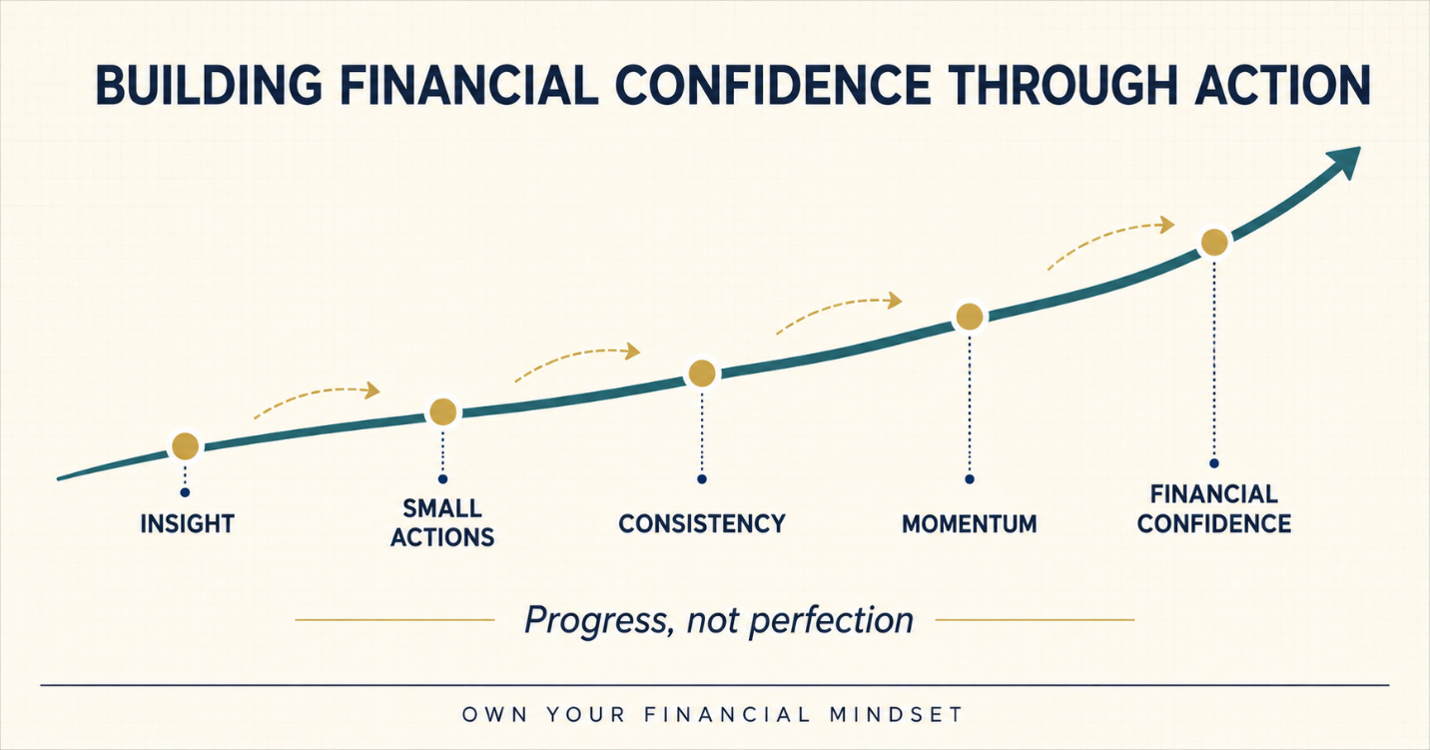
Over the past four parts of this series, we’ve explored how beliefs, cognitive biases, and emotions influence financial behaviour and how rewriting your financial story can open the door to better decisions.
Now we arrive at the most important step: Taking Action.
Awareness without action doesn’t create change, and in personal finance, it’s not what we know that drive results it’s what we do.
Why Action Builds Confidence
Many people believe they need to feel confident before they take action. In reality, it works the other way around. Confidence is built through action. Small, consistent steps create evidence that you are capable of managing your financial life. Over time, this replaces hesitation with clarity and uncertainty with momentum. Without action, even the best plans remain ideas. With action, even small efforts begin to compound.
The Power of Small, Consistent Steps
Financial success rarely comes from one major decision. It’s the result of many small decisions made consistently over time.
This might include:
- Setting up an automatic, monthly savings plan.
- Increasing investment contributions gradually.
- Reviewing your financial plan on a regular basis.
- Paying down debt with a structured approach.
Individually, these actions may feel modest. Collectively, they create meaningful progress. Consistency builds momentum and momentum builds confidence.
Reducing Friction in Financial Decisions
One of the biggest barriers to action is friction. Small obstacles that make decisions feel harder than they need to be.
This can show up as:
- Not knowing where to start.
- Feeling overwhelmed by too many options.
- Delaying decisions due to uncertainty.
- Relying on willpower instead of systems.
The solution is to simplify and automate wherever possible.
Helpful strategies include:
- Automating savings and investments.
- Creating clear, predefined financial rules.
- Breaking large goals into smaller, manageable steps.
When decisions become easier, follow-through becomes more consistent.
Turning Intentions into Systems
Intentions are important but systems are what create results. Instead of relying on motivation, build structures that support your goals.
For example:
- Rather than planning to “save more,” set up automatic contributions
- Instead of “investing when the time feels right,” commit to a regular schedule
- Rather than reviewing finances occasionally, schedule consistent check-ins
Systems reduce the influence of emotion, helping you stay on track even when motivation fluctuates.
Progress Over Perfection
A common barrier to financial progress is the belief that decisions need to be perfect. They don’t. Waiting for the perfect time, the perfect strategy, or the perfect amount often leads to inaction.
Progress is built through:
- Starting before you feel fully ready.
- Making adjustments along the way.
- Learning through experience.
Small, imperfect actions taken consistently will always outperform delayed perfection.
Staying Consistent Through Uncertainty
Markets will change. Circumstances will evolve. Emotions will come and go. Consistency is what creates stability through all of it.
This means:
- Continuing to follow your plan during market volatility.
- Avoiding reactive decisions based on short-term events.
- Staying focused on long-term goals.
Consistency doesn’t eliminate uncertainty, but it helps you navigate it with greater confidence.
The Role of Accountability and Guidance
Taking action is easier when you’re not doing it alone. Having a structured plan and an external perspective can help:
- Identify blind spots.
- Keep decisions aligned with long-term goals.
- Provide reassurance during uncertain times.
- Maintain accountability and momentum.
In many cases, progress accelerates when there is support and guidance along the way.
Financial confidence is not built through knowledge alone. It’s built through the awareness of beliefs, biases, and emotions, a willingness to challenge limiting patterns and to have consistent, intentional action over time.
When these elements come together, financial decision-making becomes clearer, more confident, and more aligned with long-term success. Own Your Financial Mindset
Karen Boudewyn, Senior Wealth Advisor