

by Kristina Quapp
Vorticism was a radical but short-lived avant-garde art movement of the early 20th century that embraced the dynamism of the machine age. Vorticism featured hard edges, geometric shapes, bold lines, and harsh colours that teetered towards abstraction. Inspired by Cubism and Futurism, Vorticism combined the static geometric structure of Cubism with the dynamism of the futurist movement.
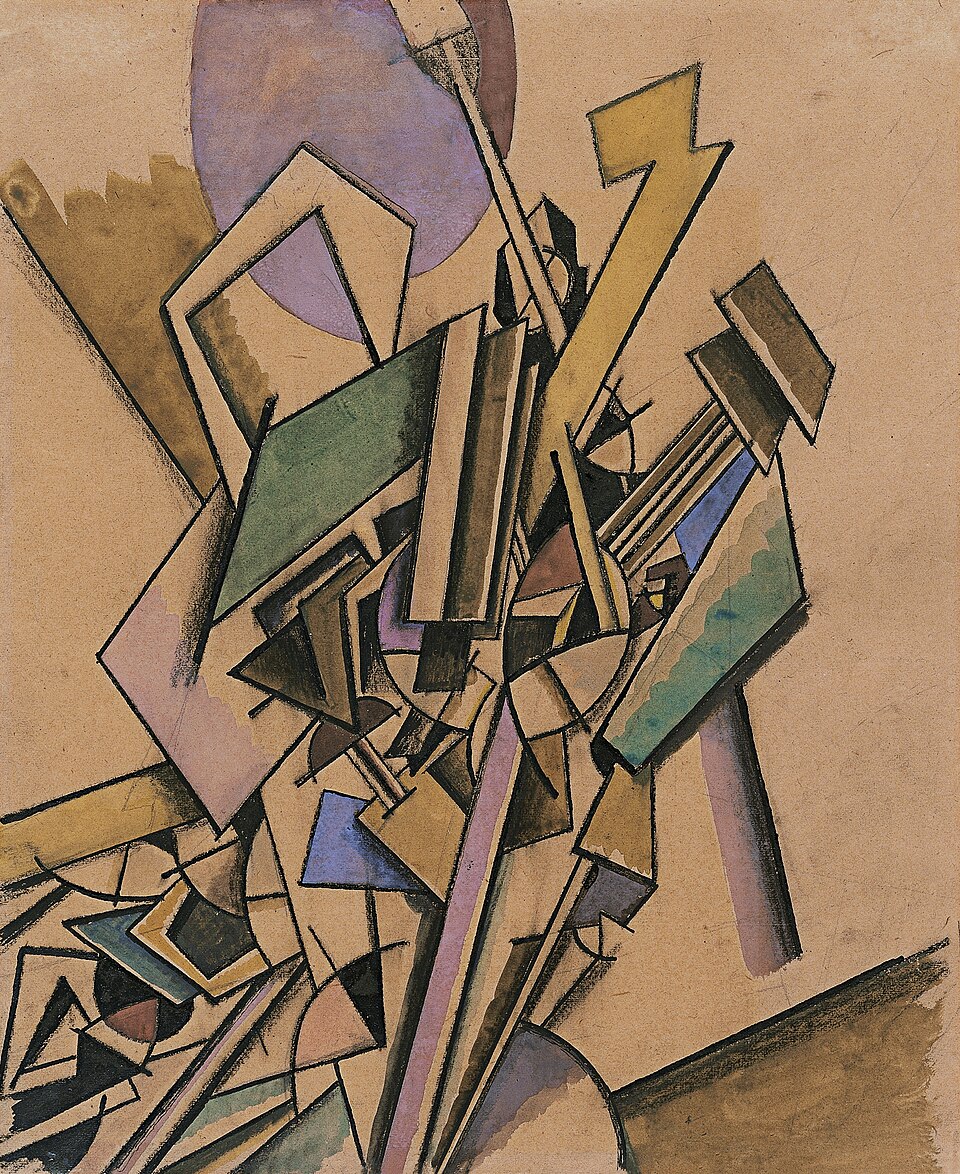
Edward Wadsworth, Vorticist Study, 1914. Public domain.
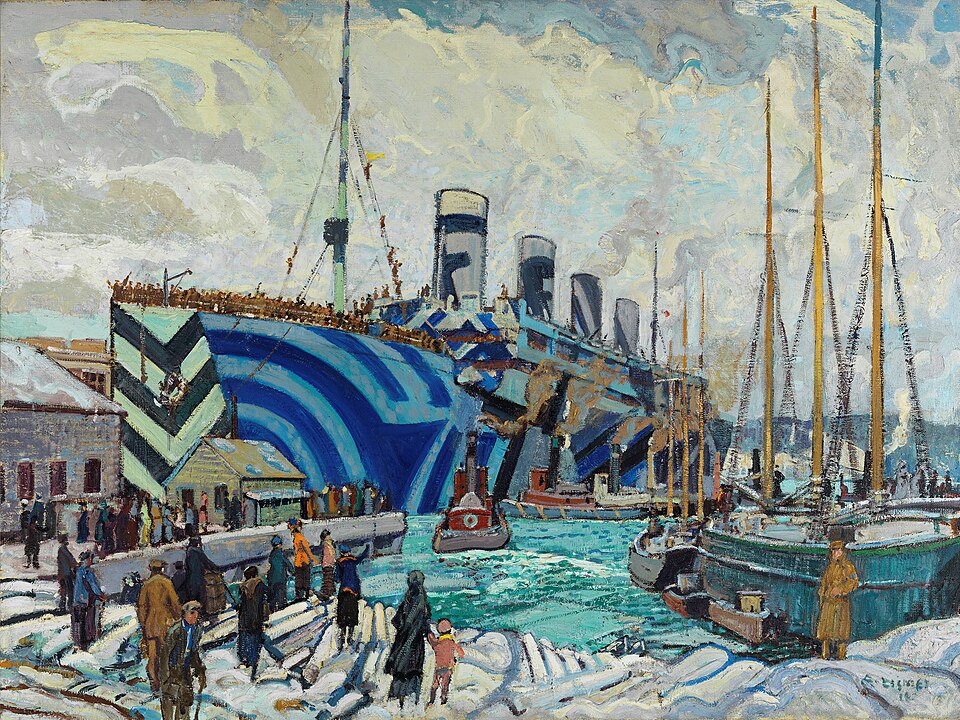
Emerging around 1914, Vorticism was quickly interrupted by the outbreak of the First World War. Many artists involved in the movement enlisted, and the horrors of mechanized warfare shattered the romanticized view of industrial machinery and the machine age. Canadian-born artist Wyndham Lewis, often considered to be the founder of Vorticism, enlisted in March 1916. While Vorticism was being interrupted by war, its bold geometric aesthetic would soon find an unexpected parallel in a very different setting: naval camouflage. In 1917, British artist and Royal Naval Volunteer Reserve officer Norman Wilkinson began developing a radically different approach to camouflaging ships. While serving the Royal Naval Volunteer Reserve in 1917, Wilkinson took note that German U-boat torpedo attacks were doing significant damage to British forces, sinking roughly eight ships per day. Wilkinson concluded that if painting ships to try and hide them wasn’t working, the goal should be to make them harder to target through a German U-boat’s periscope. To successfully hit a moving ship, a U-boat commander could not simply aim directly at it; they had to calculate the lead angle and fire where the ship eventually would be by the time the torpedo arrived. The calculations of a ship’s speed, range, size, and course needed to be precise; Norman Wilkinson calculated that throwing a U-boat gunner’s calculations off by just 10 degrees was often enough to cause a torpedo to completely miss the vessel. Dazzle camouflage, also known as “Razzle Dazzle” distorted the ship’s silhouette, confusing the enemy as to whether the ship was moving fast or slow, and which direction it was sailing. The intention was to cause U-boat crews to miscalculate, causing a torpedo to miss, graze the vessel, or strike a less critical area.
Vorticist artist Edward Wadsworth served in the Royal Naval Volunteer Reserve, supervising the application of dazzle camouflage to ships. After the war, he and other artists returned to the canvas, capturing the striking vessels and preserving their place in wartime history.
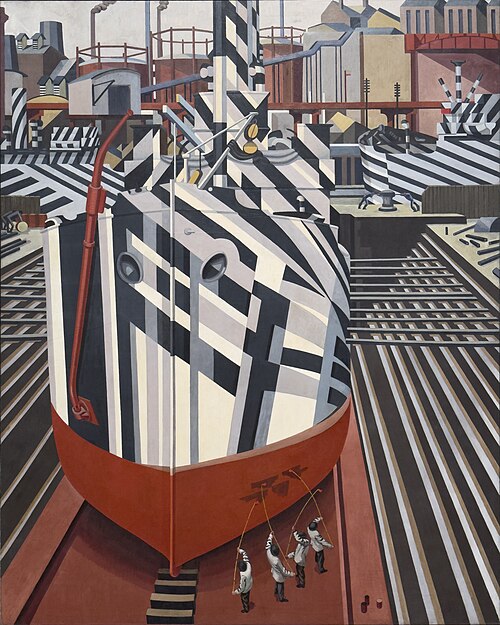
Edward Wadsworth, Dazzle-ships in Drydock at Liverpool, 1919. National Gallery of Canada. Public domain.
Vorticism celebrated the energy and machinery of the modern world, only to be interrupted by a war defined by those same forces. Through artists like Wadsworth and Lismer, art became a way to document what followed and preserve pieces of the First World War experience. This Remembrance Day works like these remind us that remembrance takes many forms. Through stories, photographs, monuments, and art, the experiences of those who served and sacrificed continue to be shared and remembered.
Lest we forget.